Letter from the Editors
words by Sana Friedman & Aliza Susatijo, art by Mariam Seshan
Dear Readers,
Welcome to Volume IV, Issue IV: Fire & Ice. Bundle up (and get ready to sweat) as you traverse this dual terrain of flames and frost.
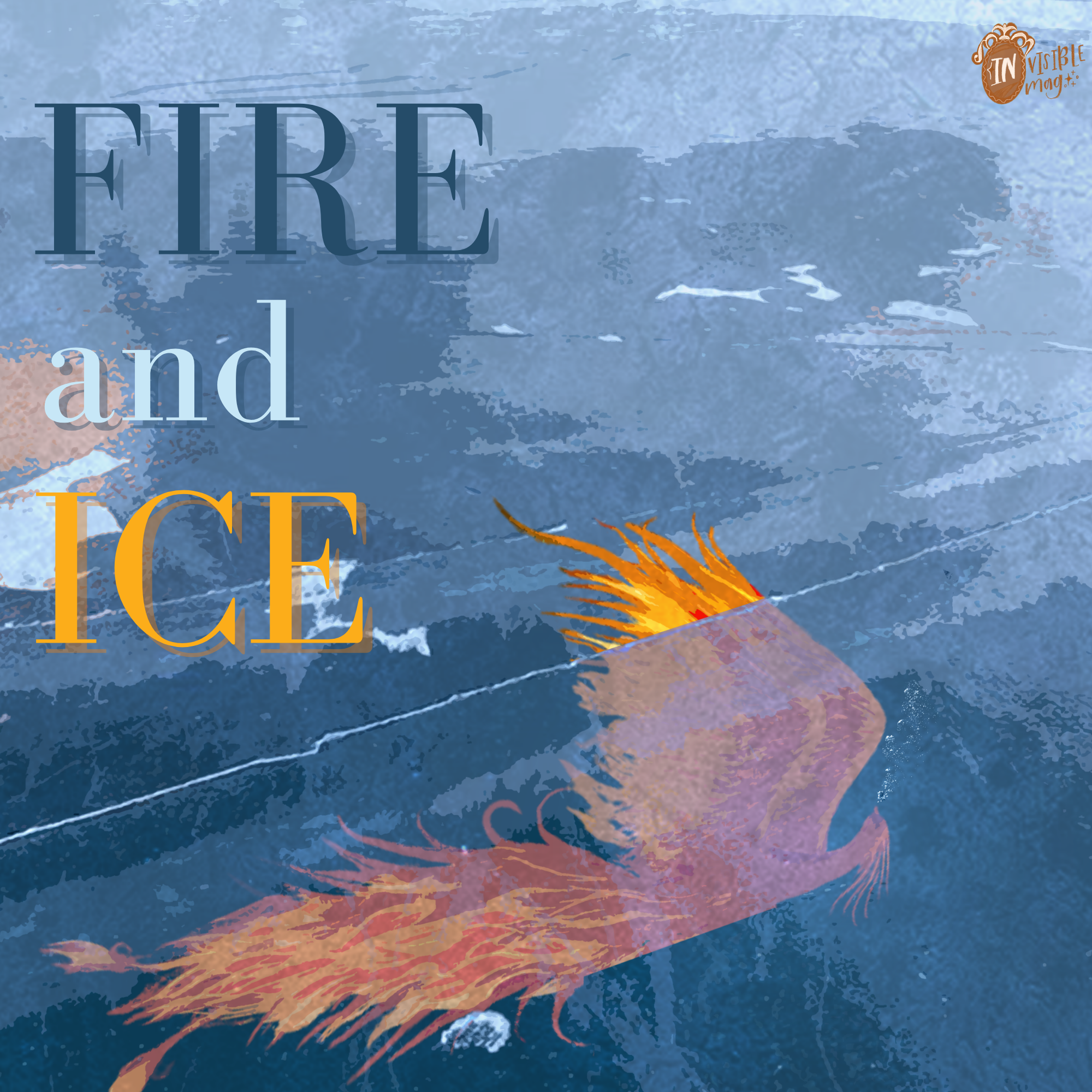
We open with Ananya Sairaman’s portrait of a jacketed figure collapsed in the snow and cloaked in dusk. In fierce contrast with the blueness of nightfall, orange flames billow up from their torso, representing the burning sensation of hypothermia. In “Somewhere Just Above the Center of Hell,” Scarlet M. spins this duality into a kind of parable. Condemned to captivity, the character is subjected to a “twisted cycle” of burns and frostbite. Fire and ice merge within the fates of both Ananya and Scarlet’s characters; here, they’re not rivals, but collaborating forces of ruin.
This theme continues in Elaine Ruan’s piece, “The Same Second,” in which two characters encounter opposite apocalypses. As Marina’s world is engulfed in flames and Aidan’s in ice, they try to find refuge in the opposite element. Riese Carlson accompanies Elaine’s story with an intricate, black-and-white illustration of two birds. One’s plumes are made of tendrils of fire, and the other, the crystalline dendrites of a snowflake. Their symmetry is formed by their contrast.
Lanie Myaing overlays a photo of a Lawn room fireplace with an ornate illustration. She deviates from the characterization of fire as merciless and destructive, instead depicting it as a source of comfort. Liah Chung’s “Lost and Found” embraces a similar ambiguity. In her allegorical story about suicide and self-forgiveness, the flaming, burning Sun brings about both beginnings and ends.
Echoing Scarlet’s piece, Avery Carlson’s “Frozen Flames,” revisits the assumption that fire and ice are opposites. They portray fire in all of its dimensions— punishing, demanding, numbing— to suggest that ice is a force of the same passion. Justina Lu’s illustration asks the same question: “are [fire and ice] so different?” She draws a campfire with flames hued both red and blue, and the firey peaks blend with the glaciers in the background.
Lastly, Pauline Tsui tells a story from two vantage points: those protesting in the streets, “fire in [their] mouths / [chanting] in frozen blocks,” and those who “sit still in luxury.” The latter crowd bunkers down in newsrooms and broadcast stations where “language is refined / into bullets / until responsibility disappears.” Sana Friedman’s art piece translates the red and white stripes of the American flag into the bars of a prison cell. Silhouettes between them are the figures of young children, who are reaching up to grasp stars that are falling from the sky.
As always, we want to thank our incredible staff and editors for making this issue happen. As snow piles up outside and the days only seem to get longer, most of us have been burning the midnight oil. And, though we’re starting to see spring, the ICE persists. Our APISAA community is horrified by the violence being waged against our immigrant and non-immigrant siblings, as well as the chilling of free speech occurring in every corner of our country. As artists, as Asian Americans, and as young people, we bear in mind how both fire and ice rage around us: the subzero temperatures in which people of conscience in Minneapolis are defending their neighbors; the pyrotechnics of flashbangs and tear gas used by the state against them; the coldness of those who look the other way; the warmth of community. Let us continue to stoke the flames in our hearts. When we keep each other warm, the ice can begin to melt.
With all our love,
Sana & Aliza
