Pieces
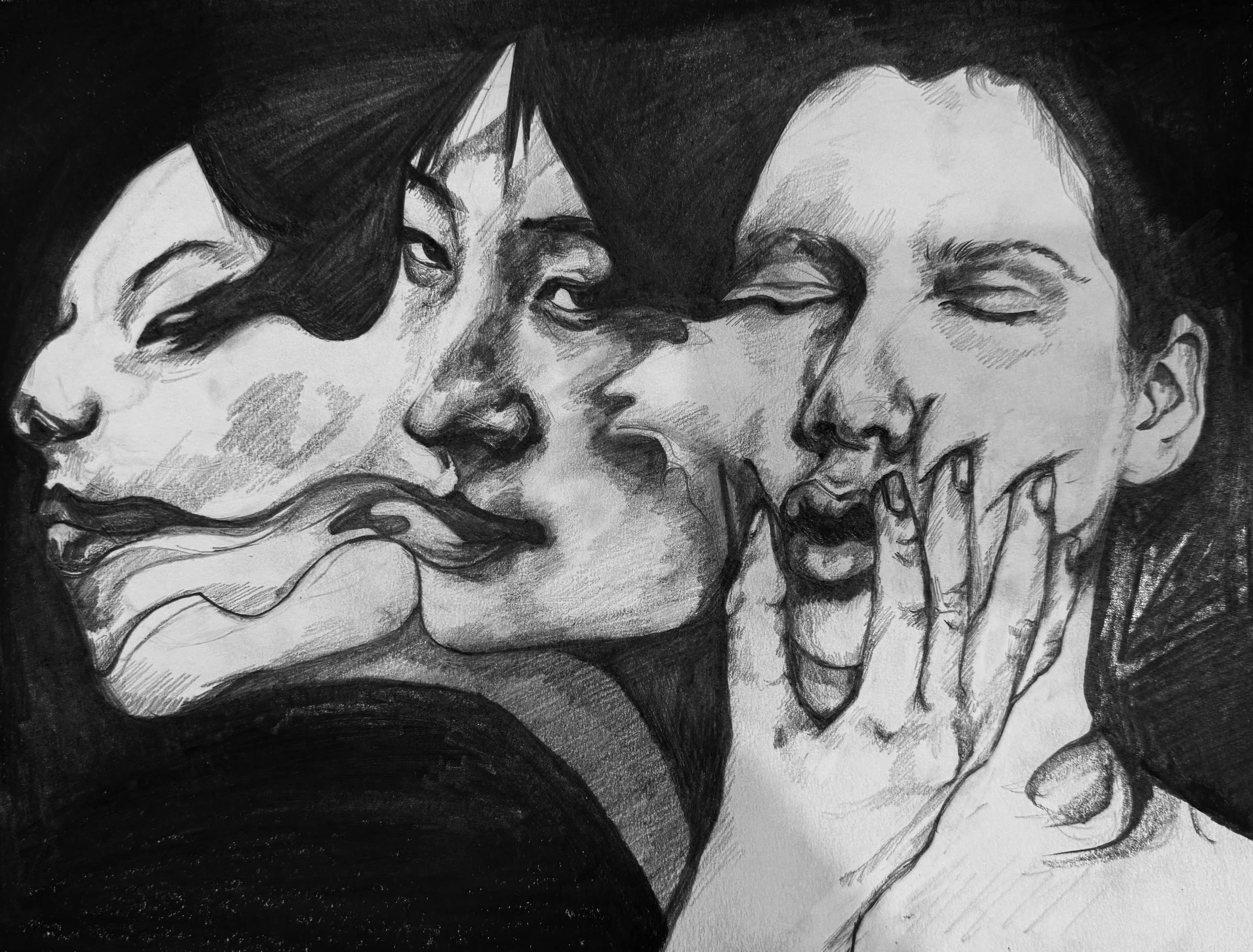
words by Evan Thorn, art by Mia Kang
04:45
Dark mornings do not feel so wrong after a time. It is unsettling at first; I think it is because you are trying to fill a space that is much too big for you. But eventually you become accustomed to it. Residency makes early birds of us all.
The parking lot is never empty. I idle my car, parked amidst a dozen others all scattered and dim. Closer to the doors are a couple of ambulances, just alongside the great sign reading “Holaghan General.” My windows are rolled down a bit. It is enough to let the sound of crickets punctuate my phone and its hollow tone.
“... leave your message after the—”
I wait a moment, just for good measure.
“Hi, Mai! You’re asleep, I know, but I thought I’d leave a message. I’m still planning to come by tonight, so maybe call me back if you can. I don’t know how late I’ll be…”
A new car pulls into the lot. I clear my throat.
“Anyways, I love you lots! Study hard today, and make sure to call me! Bye.”
I hang up. A minute passes, and I let myself be quiet, tracing with my eyes the hospital’s newest lines. These buildings rise like monoliths of white slate. Beside them, the old wings of Holaghan General look insignificant. It is like they are being eroded, surrendering to their shining synthetic siblings.
05:04
I sit in the lobby of the ACE building. The space is vast. Every surface is a white, a gray, or a marble so polished that you can see yourself mirrored every way that you turn. That is until you reach the walls. Here, screens stretch from floor to ceiling, casting light that blooms mutely. Silent montages stream across these. Families laugh, friends play, but there is no noise to accompany it—only monochrome text across the very bottom.
I eat my breakfast with my earbuds in. I usually start the morning this way, with Springsteen and a bacon-egg-and-cheese. When I was still in med school and didn’t have my own place, Mai and I would eat breakfast together just like this. She didn’t used to like classic rock, but now she says she does.
For the first time that I can remember, I have company. The boy sitting across from me—17, maybe older—sneaks glances at my food. Eventually he stops hiding it. He looks a little ashamed, and suddenly I find that I am not so hungry. I remove my earbuds and hold out the remainder of my sandwich.
“Have you eaten?” I ask. “Please, take it. I don’t eat much in the mornings anyway.”
I smile at him encouragingly, and he takes the food. I continue to smile, but as he takes small bites of the sandwich, the look of shame does not fully go away.
“Visitors don’t normally arrive this early,” I say, hoping to put him at ease. “Whoever you’re here to see must feel very lucky.”
“I…” he hesitates, but though his voice is gentle, it is clear. “I’m here for surgery.”
I still have questions, but there is still a fragile look in his eyes. There is no good way to describe it—no good way that I know of—so I decide that it must be fear.
“I take it you’re here for an ACE operation?” I try asking. “I’m a resident surgeon, actually. I go by Dr. Luu, but you can call me Huy. If you have any questions, I’d be happy to answer them.”
“Oh.” He answers quietly before pausing. “Okay.”
A moment of stifling silence passes between us.
He then waves awkwardly before answering hesitantly. “I’m Kenny.”
He goes quiet again, and I decide it is better that I start talking.
“People can get a little nervous when they hear about it,” I say. “‘Soul surgery’ is sort of an intimidating idea, but it’s truly very safe. Holaghan was one of the first hospitals to implement the technology, so your doctors are some of the most accomplished in the field.”
“Hm. Okay.”
“And if you’ve been screened and cleared to be a donor, that means your soul is strong enough to receive the procedure without any complications. They should be able to extract the transplant without any risk of stripping too much.”
“Oh. Well. I’m not actually a donor.”
I falter, but I let my composure slip for only a moment before my face is arranged once more. I smile, still hoping to make him comfortable, but I cannot help but take him in differently.
“I’m sorry, I shouldn't have assumed.” I bow my head. “But if it eases your mind at all, the process for receiving a transplant is even simpler. It’s a matter of fine suturing, but the soul is a highly adaptive organ. It does most of the work naturalizing the new layers.”
“Hm. Yeah, I don’t know…” Kenny swallows the last bit of sandwich, staring morosely at his hands. “I guess I’m still just not so sure about it.”
Cases like these aren’t uncommon. Relatives, friends, even physicians and psychiatrists prescribing ACE to a reluctant loved one or patient. It’s not uncommon for these people to arrive apprehensive.
“If you don’t mind me asking what brought you here…”
“It’s my parents.” Kenny meets my eyes, revealing more of that unnamable emotion. “They think I’m depressed.”
“Soul transplants are not uncommon as a remedy for mental illness.”
“I know. I’m just not sure I’m ill is all.”
“Have you been diagnosed?”
“One doctor diagnosed me. So yeah, I guess I am ill. I don’t know.” He shrugs, but instead of raising his shoulders, it is more like he is shrinking into himself. “I feel like I could get better without all this.”
“Kenny, I’m sure you know this already,” I say slowly, “but depression is not always treated easily. There can be a number of psychological, biological causes contributing to your condition. Very often, the most comprehensive mode of addressing those is with a soul transplant. I’m not sure if there’s any more efficient way of making you better.”
He shrugs again. “Medicate me.”
I pause for a moment, trying to mask my clumsy search for words.
“Kenny,” I begin. “I once donated layers of my soul to someone very important to me. She dealt with something very similar to you. I don’t think any of us realized how much she needed the transplant until after it was complete. You should see her now, though. Now, she’s able to live easily along with the rest of us.”
“It’s just… I don’t think my soul is weak.”
“No, no, don’t think of it in those terms. Physically, though, there are anatomical differences in organ thickness—staunchness, we call it, and—”
“I don’t see why that should make a difference, though.”
I struggle to find the right words. The light from the lobby walls seems to reach further, touching the place just beyond our seats. The silent figures on screen share a meal. The restaurant is vague, unobjectionable, unimportant. The people are all smiles, sharing jokes we cannot hear. It is as though the videos are attempting to evidence my point, showing images of what strong souls ought to look like. I cannot find a way to describe this myself, and Kenny can tell.
“Sorry,” he says hastily, and there is genuine feeling in his voice. “You’re right about the anatomy thing, I’m just… I’m not sure that means anything. My soul feels how it’s supposed to be. Depression is a different thing. But I’m not mad at you for trying to explain it to me. I know it’s your job.”
“No, that’s not it!” I stammer. “I mean, it is, but that’s not why…”
Kenny is watching me with that same look, and I can tell he doesn’t know how to make things simple again. My heart aches a bit.
“I just want you to feel okay about all this, Kenny,” I say, hoping he cannot hear the way my voice comes out ever so slightly desperate.
If he does, I cannot tell. He only shrugs.
06:13
I make my patient rounds. The process is routine, and my mind is left to linger over my earlier conversation—one that I reflect upon now as being something closer to a dogmatic interrogation.
I exit the second-to-last ward on my list. I replay the encounter with Kenny in my head, wishing I had explained the operation some other way.
Animatic Clinical Excision. The name, I’ve always thought, is almost as clean as the procedure itself. Because while the effect of removing thin strips of the soul is difficult to define universally, it is a process that encounters minimal complications.
The soul is elaborate in ways even the heart and mind are not. Some see it as contributing to a sense of self; others believe it is a mechanism for storing deep, psychophysical memory; some even imagine it as the source providing our will to live.
Does it matter how you interpret it? Is it not clear how strength is vital? How staunchness is vital? No one soul is the same, but with such clear physical indicators, is not the reason for reinforcement obvious?
I check in on the last ward as seamlessly as I did those before it. When I see Mai’s call, I do not let the phone ring longer than a second.
“Morning!” I say cheerily. “Are Mom and Dad up yet?”
Her good morning comes more groggily. I can hear footsteps for a moment before she informs me that no, in fact, Mom and Dad could not be further from up.
“Figures. Anyways, you looking forward to school?”
She says she is. She spends a minute talking about a class and a teacher she says that she loves. I smile, because Mai did not always talk about school so enthusiastically.
“That’s great!” I listen for a moment, then laugh. “No, really! If there’s anyone bookish enough to get where you’re coming from, it’s me.”
Her words come faster then as she begins to rant about an exam she has coming up. She talks hurriedly about a harsh curve, citing every rumor she has heard and every warning she has been given.
“Mai—hey, Mai, listen,” I say. “Just do like I always say. Take things slow. Don’t let it get to your head, because you can always trust yourself. Okay?”
She says okay, and I know she’ll be just fine.
“All right, I have to go. Still not sure when I’ll come by, but if you all are cooking dinner just save something for me, okay?”
She makes no promises, and I laugh.
11:40
Lunch is never very eventful. For ten minutes I tuck myself into whatever corner of the hospital I find myself closest to. On good days, I have something packed that I can grab easily: a yogurt, maybe some granola, a bagel with some peanut butter over it.
But today is not a good day.
When the door to the surgeon’s lounge opens, I am hunched over a protein bar, distractedly entering patient notes into a computer.
“Luu, I’d like you to work as primary in the Milton case.”
The bar is a dense lump in my throat, and it takes me a moment to swallow.
Dr. Stephens stands in the door, neither in nor out of the room. I’ve stopped questioning what freezes him there, suspended so solidly between one place and another. Of the attending surgeons, he is the most distant with his residents. He is also my favorite.
“Primary?” I repeat, not sure how to voice the rest of my question.
“All of my first-years serve as primary at some point,” he says evenly. “I will be supervising throughout the operation. You will go back to assisting in your remaining cases. This is simply one opportunity to apply your experience.”
I nod, but when I rise to my feet, he waves his hand for me to stay.
“The operation is still two hours from now,” he says. “I have you on the recovery team. I recommend most residents take some time to clear their head before entering the operating room.”
At last he moves beyond the threshold. Tall and sturdy, he crosses the room in three firm steps. He rests a file on the desk—Dr. Stephens is the only ACE attendee I have met who makes analog copies for every case.
“I’ve cleared your schedule for the remainder of the afternoon. I’d like you to prepare before then. Review procedure, read up on the patient. It should be quite standard.”
“Can I meet with her?”
It is such a small change. His eyes become clearer, his body more alert. For just a moment, he becomes present.
“Meet with her?”
“Elodie, the patient. Ms. Milton, I mean.”
I have the file open in my lap. Her picture looks up at us, surrounded by cramped typeface. A few crumbs from my desk fall onto the pages. I quickly brush them off.
“I don’t think that will be necessary,” Dr. Stephens says. “If a donor has been screened and authorized, then there is generally little need to establish any additional information. Her soul is adequately staunch to receive the procedure.”
“Ah, right. I understand.”
“I’m looking forward to seeing you work, Luu.”
He smiles—a gesture that is short and sincere. He has always been this way, but bruqueness from him has only ever seemed professional to me. There is something reassuring in his detachment. I have practiced that smile in the mirror, imagining how I might speak to a patient, a family, a resident of my own.
After he leaves, I examine the first page of the file. Dr. Stephens was right: the case is ordinary. It is not long before I set the papers down. I look at my reflection in my phone. My smile is open, imprecise.
I have much practice left to do.
13:30
The surgical suite feels wrong with so many people. Surgical assistants, anesthesiologists, and medical technicians surround the operating table, passing between each other a dozen thin files that I have already previewed. Most of them will vacate soon; this is all routine.
I stand at the center, but nobody seems to be paying me much attention. It is the assumption that the only thing keeping me from performing the procedure myself is the disappointing fact that I have but two hands. My breathing is steady, controlled. My preparation already complete, I let myself disappear amidst the professional babble of the surgical staff.
I listen to the middles and ends of their sentences, but mostly I watch Dr. Stephens. He stands by the table that holds my instruments. He examines the way I have arranged them but offers no comment. Even if Dr. Stephens were the overbearing type, he would find nothing to critique in my organization. I model mine after his.
The suite is colder than I am used to. The walls, the cabinets—everything is an empty, inoffensive white. Every corner appears rounded out, making the room feel soft and a little undefined. An attendee once told me that physical comfort swells the soul just slightly, making the operation that much simpler.
I take the patient file from an assistant’s hands, who does not for a moment slow her talking as she absently relinquishes the folder. It does not take much searching to find what I am looking for.
The note is smaller than it ought to be. The entire section, which is fitted into a neat corner of the third page, is uncomfortably brief. The patient’s medical history is outlined in a condensed array of bullet points. It is not an extensive report. She has been screened, after all.
It is written small like everything else, but it was enough for me to look further. The incident was only a year and a half ago. She had been seen one building over in Hologhan’s ICU. The records were easy to track down.
For the procedure, it makes no real difference. And yet…
I announce to the room that I’m going to use the restroom. They hardly notice, and I leave the surgical suite.
13:39
When I knock and enter, Elodie rises to her feet. She is the only one there. The pre-op room feels less engineered than the rest of the ward. Papers are left peaking out of drawers forced shut. Computer monitors have been left on, displaying the half-complete thoughts of nurses, physicians. Every hospital bed is raised to a different position. Not one is occupied.
Elodie hovers over a chair—one generally intended for visitors. She is young, with round features and shoulders that slump slightly down. Her hands are clasped together loosely.
“Hello, Ms. Milton,” I say.
For some reason my voice comes out gentler than normal. There is something meaningful in the quiet raptness she displays, the way she bows her head the smallest bit and keeps her hands before her.
Maybe it is just me. I cannot help but think of her file. It is wrong to let that shape our interaction. I know that.
“Oh, hello. I don’t think we’ve met.”
“No, of course, I’m sorry. I’m Dr. Luu.”
I pause a moment too long. Elodie’s hands tense as she fidgets.
“It’s nice to meet you, Dr. Luu.”
“Yes! Likewise.” I shake my head. “You’ll have to forgive me, I was distracted. I wanted to introduce myself as the primary surgeon assigned to you. I know you’ve already spoken with Dr. Stephens, but I’m happy to answer any questions.”
Elodie bobs her head. “I see. No questions, I don’t think.”
I beckon her to sit, and she does so. I lean against the hospital bed. We make a strange sight, I’m sure: a patient sitting bedside and her doctor upon the bed. Elodie smiles, a little timid. I recall the feeling of waiting alone, trying to imagine how it will feel after they have taken a piece of you.
“I’m sure you have heard this by now,” I say, “but this procedure only sounds daunting. You’ll be sedated throughout the operation, and all you’ll notice afterward are a few stitches along your back. You have nothing to worry about, truly.”
She gives a small smile. “It’s very kind of you to be so patient. I think I’ll be okay.”
There is a quietness that follows.
“Actually, Ms. Milton, I wanted to talk to you about something. About a visit you made to Holaghan a little over a year ago.”
This is all it takes for her face to fall. I can feel my body tense in protest, hating the way I have made her fingers lace tightly once more. I search for something to say—something that will not make her feel interrogated.
“I truly don’t mean to pry,” I continue delicately, “but I looked at your records. What happened to you… I wanted—”
“We don’t live with him anymore.”
She looks at me directly. Her voice is clear. No patient has ever looked at me like this, so vulnerable and honest.
“If this is about who will look after me in recovery,” she says quietly, “I’ve already got my sister coming into town. She’s got a new job here anyway, so it’s okay.”
“Ah. I’m glad.” I clasp my hands. “But truthfully… I wanted to ask if you still wished to continue with the procedure. I know you’ve been screened, but it’s not common that people in your circumstances undergo such a significant operation. It is really a wonderful thing that you’ve managed to move on in the way you have. I’m not sure removing any more of your soul would be… productive.”
The last word is all I can think of, and I feel disgusted with myself.
“Dr. Luu,” she says in even tones. “I don’t think you realize just how ordinary this is. Can you imagine how many people before me have come to you already hurt? You let them give up bits of themselves all the same.”
The hum of the AC is a dull drone in my ear, the air itself sending goosebumps across my skin. Elodie’s voice is so calm, smooth. Her words are like leaden weights upon my chest, yet when she stops talking I find the pauses even more suffocating. I need the respite of her voice. Anything but this vacant sound that I cannot drown out.
“I’m here because I got lucky,” she smiles wanly. “Because for once in my life, there is a piece of me I can sell away at no loss.”
“Please don’t say that—”
“But you people gave it value! You told me mine was worth more than someone else’s. It is an awful thing, but if somebody wants to make themselves more like me at your insistence, what right do I have to stop that?”
“Ms. Milton…” My mouth feels dry. “We’re not making them more like you…”
“Aren’t you?” she asks, eyes sullen. “You would attach a piece of my soul to another because you think it will fix them—being more like me. But you don’t know me. You didn’t until today.”
I swallow. “You talk like you do not want the operation.”
“I’m not really sure that I do.”
“Then why go through with it? Why tell me these things and still have it done?”
She doesn’t speak for a moment. My hands feel clammy, all the light in the room dizzyingly bright. I want to ignore the watch on my wrist, the clock on the wall.
“When we left Wes,” she says. “My daughter needed… He was the one who paid for her medication, see. And the insurance only goes so far.”
“I… understand.”
I let something slip away from me then. Some kind of confidence or belief in the solidity of things. Of ideas, of words. It goes more easily than I would have thought.
“I’m sorry, Ms. Milton. This was horribly unprofessional. Please forgive me.”
She shakes her head. “It’s all right. You have to know these things.”
That is all she says, and it is not enough. But there is nothing to correct in the pre-op room.
So I leave.
14:06
Sedated and prone, Elodie does not look so timid. She is facedown, making it impossible to know whether her eyebrows are still drawn taut. She wears a hospital gown now, and she is watched over by a vigil of surgical attendants.
My hands are on the scalpel. The operation begins simple. For now, I am like any surgeon.
Dr. Stephens is beside me. I don’t look at him. I know how he will appear, and besides, there is no room in my mind for both Elodie and him.
The case is ordinary. I remind myself of this, but the words don’t mean anything.
14:09
The incision is complete.
A thick protective layer, appearing as a synthesis of bone and cartilage, is all that remains in the way. It is a crucial evolutionary development, but one that can be circumnavigated. I swap tools, and soon the shell is parted and held open with retractors.
I stand over the soul. The organ is small—just a purple-red nub fixed right between the shoulder blades. The lights positioned along suspended metal arms wash the cavity in stark white. I adjust the arm bearing the magnifying lens, moving it closer to focus the fine, interlocking fibers of the soul.
Every ACE-trained medical student must practice upon the deceased. It is morbid and at times sickening, but there is no other way to simulate the patterning of soul tissue. The removal of a layer is a painstaking process. The distortion of the surface grain makes each soul a unique challenge to excise. Many cuts must be made at a variety of angles, until at last a strip can be neatly removed without doing injury to the inner organ.
I swap tools again, this time to a set of thin metal picks. I steady my hands. Memory, for me, does not exist anymore. There is only the work.
I set my instruments against Elodie’s soul.
14:11
Colors fill my vision. It is not beautiful or right. Not like it should be.
I can see a memory. There is grass and trees and smoke. I turn to seek it out, to fill myself. It is on the air, acrid and wonderful and confusing, but from where?
And then I see the grill, red and dented in.
And then I am gone.
There is a child in my arms. I am crying still, and somebody is banging on the door of the delivery room. They won’t let him in; they tell him he needs to settle down, else he’ll distress the mother. I don’t listen to them, because I am crying and holding a girl with eyes like mine—eyes that finally seem beautiful to me.
And then I am gone.
More colors, this time. They flash past before I can name them, but they all follow the same palette. It is enough to make an impression.
And then I am gone.
I am against a door, trying to lock and hold it shut. But it is no use, because the lock broke almost a year ago, and tonight I am not strong enough. He shoves opens the door. It is only later that night, when the doctors are done stitching me up, that I can be strong in the way I want to—that I can cry without thinking about whoever will care.
Then the nurses lead her in and she is hugging my arm. It is that same girl with the beautiful eyes. She loves me! She loves me!
And then I am gone.
My life comes and goes out of order. I am alone most of the time, but there are always the colors. Sometimes my girl is there, other times not. There are other people too. People, places. Lights cascade across the shores of my vision, married to sounds that do not fit them. I am a thousand things, all of them grand.
Slowly, we separate, and I remember myself. But it is not enough.
I do not see anymore. All I can do is feel everything she does, except that I will never feel it as intimately. This is what it is to know a piece of her soul. It is a fine existence, but my mind screams in pain knowing that it cannot make it mine. I am her, but I cannot be her.
But I am.
And then I am gone.
14:16
It was a mistake, they tell me after. A minor oversight. With some patients, they say, it takes longer for the anesthetic to carry to the soul. Unsedated, the organ can react instinctively to external triggers. The imagery it induces is largely unstudied; such cases are more recent and difficult to research.
Regardless, it was only a matter of waiting till the anesthetic worked through. They left most everything untouched. I had simply appeared paralyzed, but still very much conscious. If I feel unfit to continue, they say, then I am welcome to dismiss myself. Dr. Stephens can step in as primary.
I tell them no. I finish the procedure.
18:32
They clear out the rest of my afternoon. Something about the way I looked coming out of the operating room. That’s what did it, I think. After I’d stitched her up and handed away the piece of her. They steered me out. Sat me down.
I am now free to go. In fact, they advise me to do so several times.
Instead I sit in the lobby. The same lobby as before. The screens are on, but it all feels less important than before. The vaulted ceiling feels self-important. The padded chairs feel ignorant.
I don’t bother checking the time. I know the transplant is likely complete. Soul tissue expires rapidly; donations occur within a span of hours. I cannot leave. Not yet.
When they guide him out, I rise to my feet. There is a nurse with him, and two people I have not met. They must be his parents, the ones who left him alone this morning. I ignore them, because they too feel less important than before.
I had not known it would be him. I had looked only at his last name in the file, leaving the rest up to the transplant team. It had only been as I wandered through the hospital, dazedly peering into rooms I half-recognized, that I saw him being wheeled into the surgical suite. It took little to confirm his identity.
Kenny’s parents do not know who I am, but they see the scrubs, and they do not ask questions. The two of them support the boy, holding him at arms length and offering the slightest stability. He stumbles forward, and in a less obvious way, so do I.
“Hey, Kenny,” I say. My voice is gruff from lack of us. “How do you feel?”
He says he feels all right. Better, actually, than he expected!
“Right. I mean, that’s great! I’m glad.” I feel nervous, and I begin to bounce my leg slightly. “I know you’ve heard it already, but take it easy the next few weeks. Get some rest.”
He smiles, which I have not seen him do before. It’s different—in a good way, I think. He clasps his hands together in front of him. He says he knows, and that I’ve got nothing to worry about.
“Okay then…” I rub my neck. “And about our conversation earlier, I wanted to say I’m sorry. I think maybe I dismissed what you were saying too soon.”
His eyebrows draw taut. He says he doesn’t remember that much of what he said anyway, and regardless, I was probably right.
“Still. I don’t know. Maybe I shouldn’t have pried in the first place.”
It feels now more like I am talking to myself, but Kenny still responds. He says he understands. He says he knows I’m a doctor. That I have to know these things.
He smiles again. When they exit through the lobby doors, I do not watch them go. I am worried that with my mind still fragile, it is not Kenny I will see walking out into the open air.
18:50
You can access the rooftop from the third floor up. I discovered it in my first month of residency. The section you can walk is small, but quiet. It isn’t a secret. Lots of doctors use it to escape their work, and so it’s not a surprise that when I open the door, I find the roof occupied.
I think about going back inside, but he has seen me now.
Dr. Stephens doesn’t smoke, but he stands like a man who does. He is against the wall, leaning back and looking up at nothing. One arm is across his body; the other he rests on this one, his hand hovering in the region around his face. It is empty, though.
“You did good work today, Luu,” he says distantly. “You’ve learned well.”
We stand in the cold. The sun sets sorrowfully just behind the treeline, which we are not quite high enough to see beyond.
“Dr. Stephens…”
“Yes, Luu?”
“Why did we give that boy Ms. Milton’s soul?”
His eyes are vacant. The question does not catch him off-guard, though I cannot imagine how he anticipated it. He remains faraway as he responds.
“Her soul is stauncher,” he says. “She is predisposed to manage trauma more effectively. Stressors, triggers, extraordinary circumstances. Her ability to cope is stronger. The boy did not have those things.”
“But how can we know? How can we know that a stauncher soul correlates with those things? How can we know what a soul is at all? How, when its functions are so interwoven with those of the brain and heart?”
Dr. Stephens finally looks at me. “Luu, I should not have to explain to you how developmental science can be. Perhaps we don’t have the most definitive understanding. Perhaps all there is to it is that Ms. Milton herself was more well-adjusted.”
“I spoke with her, though! I… I worked with her soul, and I’m not sure that’s true!”
“Luu—”
“But even if it is, that means we just… just graft her identity onto Kenny? Make him less of himself so he can be more of what we think he ought to be? More of her? ‘Well adjusted?’”
Dr. Stephens pushes himself off the wall to face me. “Luu, that boy was diagnosed. His parents will tell you he rarely eats, rarely sleeps. Do you want to tell me you think he’d be better off staying like that?”
“No! Of course not!” I stammer. “It’s not a question of whether he needs help!”
“Then why not be content with helping him?”
“But this is just fixing him. Changing him.”
“Precisely. We are helping him.”
He is as alert as I have ever seen him, iron gaze bearing down on me. He is not angry. He is confident, and that is worse.
My mouth feels dry. I clench my hands, then release, repeating this again and again. The sky is dark now. I am free to go. I’ve been advised to do so several times. But I cannot leave yet. Not until I have made him understand. Or maybe not until I understand.
After a minute, Dr. Stephens goes inside, leaving me alone in the cold.
22:03
When I try to start the car, I don’t turn the key far enough. I sit for a while, doing nothing and letting it remain idle in the ignition. I shiver a bit without the heating, but the chill is a distant thing.
The last few hours I spent in the surgeon’s lounge, just like this. Sitting. Stationary.
I turn the car on and pull out of the parking lot.
The roads are not busy at this time of night—they never are. Driving becomes a mindless activity, which is a fortunate thing. There is little mind left for me to spare.
Everything around me feels textureless. The lines of the road are ghostly, ephemeral. They disappear after I pass them by, slipping through cracks like everything else. The trees that form the boundary along each side of the asphalt make shapes in the night. They spell words in a language I don’t understand.
22:30
I turn the car off, but knowing I should not, I leave the lights on. Just for now, because I am not ready to be in the dark out here. The dull yellow beams illuminate the house, half of whose windows are dark.
I climb the porch steps. They creak in all the places that I remember. Everything here is aging, not all of it well. That does not matter, does it?
Does it?
I knock four times, which is once more than I usually do. I wait with my arms crossed, even though I have a key. It is in my pocket, but for now I pretend it is not. I pretend I am different. I pretend I am someone else with a different way of walking and thinking and being.
Until the door opens, and I make myself into me. Just to see how it feels.
“Hi Mai. Sorry. I know it’s late.”
She waves her hand and tells me it doesn’t make a difference. She asks why I’m waiting out here. She asks if the car is still on. She asks if I’m hungry. She asks many questions, and I cannot answer, because suddenly these questions feel too familiar. They feel too right, too easy.
“I don’t know… Um, no, I mean… Sorry, I just need a minute.”
She asks if I’m okay, saying I should maybe sit down inside, and that there’s food saved for me in the fridge. She tells me to take it slow and places a hand on my arm. I can’t move. All I can do is listen to her voice. All I can be is still, searching every one of her words and not needing to search long enough.
“Mai… Mai…”
She speaks in slow, steady rhythms, reminding me that it will be okay—that I’m home now, and really I should not be out in the cold. She coaxes me, urging me to say something to her.
But all I can do is say her name, as if it will make her more of it.
More of her.
